Residence permits (iqamah) for students in Iran are an essential aspect of legally residing and studying in the country. These permits allow students to stay for an extended period and are renewable based on the duration of their studies.
Applications
Once an education visa has been issued and the student has entered the country, the next step is to apply for a residence permit. The hawzah will assist with this process, guiding students through the necessary steps. The application involves submitting various documents to the Immigration Police, including:
- Completed Application Form: This form is typically filled out in Farsi or both English and Farsi. The school will assist students in completing it accurately.
- Original Passport
- Copy of the Student Visa: It is advisable to keep a printed copy of the visa when travelling to Iran and to provide it to the school when needed.
- Passport-sized Photographs: Two 3cm x 4cm passport-sized photographs are required for the application. Numerous photography studios in the city, such as Namdaar Photographers located near SIOS, can take and print these photos within a few hours. Students should also obtain a digital copy of the photo, as it will eventually be needed by the school. The average cost for eight printed photos and a digital copy is around $2.
- Official Letter from the Hawzah: This letter, confirming the student’s enrolment, will be provided by the school.
- Proof of Health Insurance: The school will arrange for the student’s health insurance.
Photographers will normally keep files saved for quick re-prints. Keep a note of the code written on the back of the photographs.
This process should begin soon after arriving in Iran. Ideally, the new student should report to the school within a few days of arrival to avoid delays, as the issuance of the residence permit can take between 15 and 90 days. If the residence permit is not issued before the expiry of the student visa, a visa extension will need to be applied for. Again, this will be handled by the relevant school department; however, it is the student’s responsibility to follow up and ensure the necessary applications are made before the visa expires.
Once all the documents have been collected, the school will liaise with the Immigration Police to facilitate the issuance of the residence permit. As part of the application process, a semi-formal interview may be conducted by the Immigration Police to verify the student’s identity and carry out security assessments. Apart from this interview, it is rare for students to need to interact directly with the Immigration Police or visit their offices, as the school’s liaison typically handles these interactions.
Permits for Family Members
Family members, i.e. spouse and children, are also eligible for residence permits in Iran for the duration of the student’s education. Their applications can typically be processed simultaneously with the student’s application, although some additional documents are required. Specifically, a marriage certificate is necessary to establish a legal relationship between the student and spouse and hence, their eligibility for a residence permit. The original marriage certificate must first be legalised by the Iranian embassy in the student’s home country. This process may involve several steps, including notarisation and payment of relevant fees. (Students should refer to the Iranian embassy in their own country for detailed instructions on legalising documents.)
A family member’s residence permit is dependent on the student’s permit and will normally expire on the same date as the student’s permit!
The legalised marriage certificate then needs to be verified by the Ministry of Foreign Affairs in Iran and translated into Farsi at an official translation office before being submitted to the school with the other necessary documents; translation of the marriage certificate, original passports, passport-sized photographs, and visas for all family members. These documents should be submitted to the school, which will assist with the application process. The approval process for residence permits can take up to three months, during which applicants may need to apply for visa extensions.
Some schools also require education certificates to be legalised. To save time and money, send this to the embassy together with the marriage certificate!
Residence permits are usually valid for one year and are stamped inside the passport. However, nationals from certain countries, predominantly Western countries, can request that all stamps be placed on an external document. This system aims to facilitate easier travel in Europe and North America by avoiding restrictions imposed by certain countries and conserves valuable passport pages, which can be costly to renew.
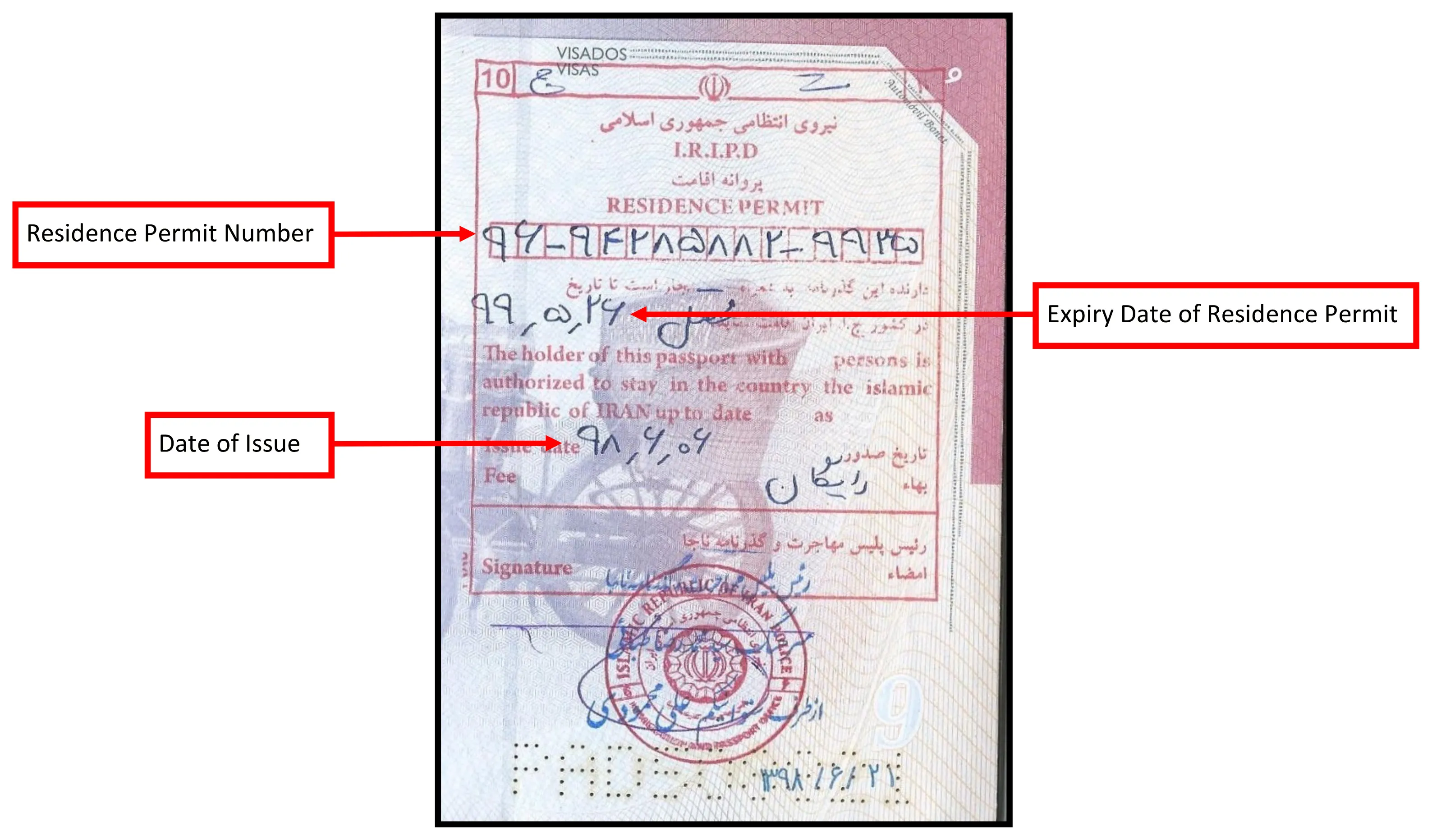
Renewal
Residence permits in Iran are typically issued for one year and must be renewed annually. To ensure timely renewal, students should submit the necessary paperwork and documents to their school between two and four weeks before the permit’s expiration. The expiry date is clearly visible on the stamp but is displayed in the Persian calendar, so students should be extra careful to calculate the corresponding Gregorian date to avoid late submissions and ensure their legal status in Iran remains uninterrupted.
There is a daily fine for late submissions, currently around $2.50 per day per person. While this amount may seem minimal, it can quickly add up and impose an unnecessary financial burden on the student. Therefore, it is crucial for students to manage the renewal process diligently.
If a passport is due to expire, the residence permit will only be issued or renewed up to the passport’s expiry date!
The renewal process requires submitting an application form, the original passport, and a photocopy of the current residence permit. Students are responsible for ensuring these documents are provided to the school in a timely manner. Once submitted, the updated passports with the new residence permits are typically returned within two weeks. The fee for issuing and renewing residence permits is around $4 but is normally covered by the school.
Documents at a Glance
A summary of the documents required for each application:
| Application | Original passport | Passport photo | Copy of passport | Copy of visa | Copy of permit |
|---|---|---|---|---|---|
| First-time permit issuance | ✓ | ✓ | ✓ | ||
| Permit renewal | ✓ | ✓ | |||
| Exit & re-entry visa | ✓ | ✓ | ✓ | ||
| One-way exit visa | ✓ | ✓ | ✓ | ✓ | |
| Visa extension | ✓ | ✓ | ✓ |
Comments & Suggestions
Have something useful to add? Share your experience, recommendations or updates with other students in Qum. This could be a change to the information above, a useful tip, a service or place you recommend, or anything else that may help others. Comments are reviewed before they are published. Please see our comment policy for what can be published and how to request the removal of a contribution.
Loading contributions…