Air
In addition to international airports in major cities like Tehran and Mashhad, Iran has numerous domestic airports across the country. Qum currently lacks its own airport, making Mehrabad Airport in Tehran the nearest option. Mehrabad Airport comprises six terminals: Terminals 1 and 2 manage departures and arrivals for ATA Airlines, Iran Air, Iran Airtour, Kish Air, Meraj Airlines, Qeshm Air, and Zagros Airlines, while Terminals 4 and 6 handle those for all other airlines.
Although airfare is more expensive than other modes of transportation, it is relatively affordable and particularly beneficial for long-distance travel when saving time is a priority. For example, a one-way, off-peak flight from Tehran to Mashhad costs approximately $40 and the journey typically takes around 1.5 hours.
A typical taxi ride from Qum to Mehrabad Airport would take between two and two and a half hours, and should cost less than $10.
There are two types of flights: chartered and scheduled. Chartered flights tend to be more budget-friendly but come with certain limitations. Once a charter ticket is purchased, it cannot be changed or cancelled, and refunds are not provided. Conversely, scheduled flights offer more flexibility, allowing passengers to make changes to their itinerary if needed. Additionally, scheduled flights often feature discounted fares for children and infants.
Rail
A popular choice among travellers is Iran’s extensive railroad network, known for its safety and comfort. The train station in Qum is conveniently located in the city centre, about a five-minute taxi ride from the shrine. With both direct and indirect routes to multiple cities, taking the train offers a convenient and affordable means of travelling around Iran. Several train operators provide varying degrees of quality and service, with some even offering different classes on a single train.
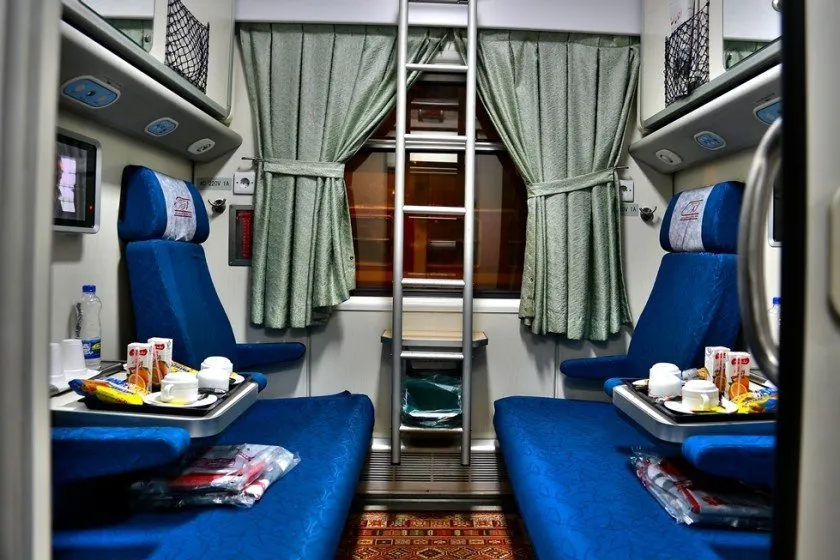
Many long-distance trains are ‘sleeper trains’, equipped with beds that allow passengers to sleep comfortably during their journey. Fresh linen and bedding are provided, along with refreshments and meals, depending on the train operator and the service purchased. Washrooms are located at each end of a wagon, which contains ten cabins, and are usually fitted with an ‘eastern’ squat toilet rather than a ‘western’ style toilet.
Cabins accommodate either four or six passengers. Six-passenger cabins are significantly cheaper but can feel cramped and uncomfortable, especially when sharing with unknown passengers. Unlike air travel, there are no size or weight limits for luggage, and bags are not checked in. Passengers are responsible for carrying all luggage onto the train themselves and storing it in their cabins. Each cabin has an overhead storage compartment that can fit two medium-large suitcases, while smaller bags and suitcases can be stored under the seats.
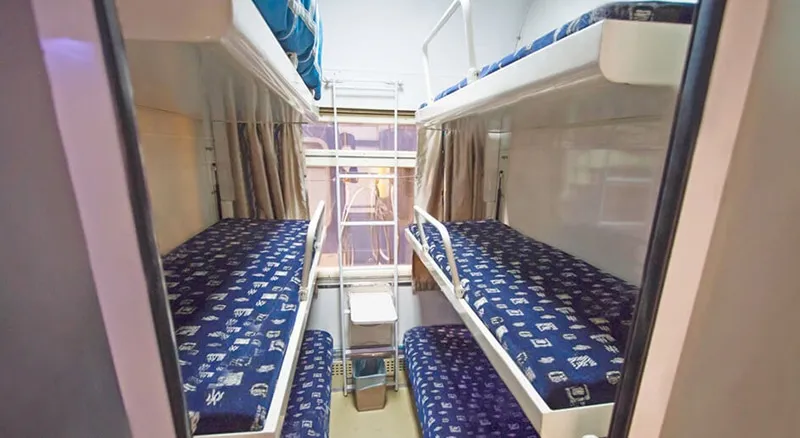
Trains stop during the journey for prayer times, but only 15-20 minutes are given for passengers to alight, use the washrooms, and pray at the station. This often results in chaotic scenes as passengers try to complete their prayers and return to the train before it departs. That being said, the facilities at many stations are decent and can accommodate large numbers of people, so travellers are advised to remain calm and perform their prayers promptly before returning to their train cabin.
Prices of trains are more affordable than airfares. For instance, a single journey from Qum to Mashhad ranges from $5 for a seat in a six-passenger cabin to approx. $20 for a seat in a first-class, four-passenger cabin. The fare for children between 2 and 12 would be half the mentioned adult price and children under 2 only pay a nominal fee. Discounts are also available for booking the whole cabin. Cancellation fees are also very reasonable (90% refund if cancelled by noon the day before departure, 70% refund if cancelled up to 3 hours before departure, and 50% refund if cancelled less than 3 hours before departure).
Road
If one is fortunate enough to have a personal vehicle, road trips are an affordable and exciting way to explore the country by using Iran’s network of highways and roads which connects major cities and towns. For those without a personal vehicle, several other intercity road transportation options are also available.
Coaches are among the most common modes of intercity transport. Qum’s main bus terminal, located on the outskirts of the city, offers regular services to numerous destinations across Iran. Several bus companies operate from this terminal, providing a range of class options from standard to luxury (VIP) coaches. Luxury coaches are equipped with more comfortable and spacious seating, air conditioning, and sometimes even refreshments and entertainment options, making long-distance travel more pleasant. Other bus terminals include Fadak terminal, which predominantly serves passengers traveling to southern and western cities of the province, and the 72 Tan terminal, which has services to cities like Karaj, Kashan, and Tehran. Many of the coaches at 72 Tan do not require advance booking; rather, passengers can simply jump on any coach with available seats and pay the fare to the conductor during the journey.
Coach fares are cheap. A typical economy coach journey from Qum to Tehran would cost approximately $1 whereas from Qum to Mashhad on a VIP coach would be around $8.
Taxis are another option for intercity travel, with both shared and private taxis available. Shared taxis usually follow specific routes to neighbouring cities and towns, many of which can also be found at 72 Tan terminal.
Travellers who require a more personalised and direct journey can arrange private taxis either through local taxi services, ride-hailing apps or reliable drivers that many students have used before, such as:
| Name | Telephone | Vehicle |
|---|---|---|
| Agha Muhammad Bahluli | 0935 610 0636 | Saloon car (up to 4 adults) |
| Agha Hadi Jahangir | 0912 552 0482 | Saloon car (up to 4 adults) |
| Agha Ramazani | 0912 753 3881 | 15-seater minibus |
Comments & Suggestions
Have something useful to add? Share your experience, recommendations or updates with other students in Qum. This could be a change to the information above, a useful tip, a service or place you recommend, or anything else that may help others. Comments are reviewed before they are published. Please see our comment policy for what can be published and how to request the removal of a contribution.
Loading contributions…