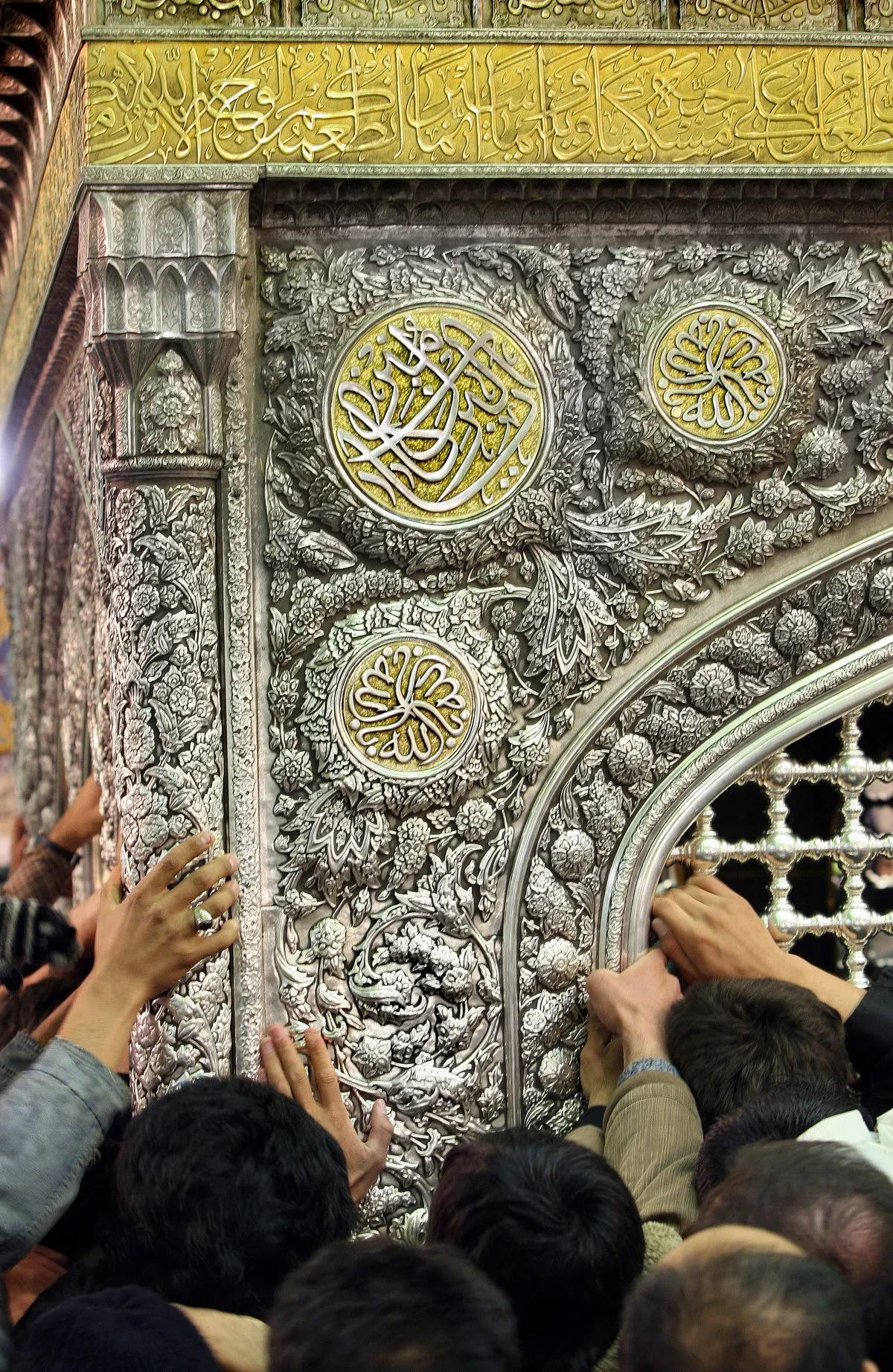
The city of Qum is not only the largest centre of Shia scholarship, but also stands as a beacon of spirituality and guidance. At the heart of Qum lies the revered shrine of Lady Masumah (a), attracting millions of pilgrims seeking solace and upliftment. The city’s rich religious heritage and atmosphere provide students, residents and visitors alike ample opportunities to engage in reflection and contemplation, ritual worship and organised programs to purify one’s inner being and develop one’s relationship with the Almighty (swt).
Birth and Lineage
Fatimah bint Musa ibn Jafar, popularly known as Fatimah al-Masumah (a) or Lady Masumah, is the daughter of the seventh Imam, Imam Musa al-Kadhim (a) and Najma Khatun. She is also the sister of the eighth Imam, Imam al-Ridha (a). There is no specific mention of Lady Masumah’s (a) birth date in early sources; however, later history books state that she was born on 1st of Dhul-Qada 173 AH/ 22nd March 790 AD, in Medina.
Knowledge
One of the qualities of Lady Masumah (a) was her considerable knowledge of the various Islamic sciences and the teachings and merits of the family of the Holy Prophet (s). It is reported that once a group of Shia entered Medina seeking answers from Imam al-Kadhim; however, the Imam was away from the city at the time. In his absence, Lady Masumah (a) wrote down the responses to their questions on a piece of paper and gave it to them. On their journey back, they unexpectedly encountered the Imam. When Imam al-Kadhim (a) saw the questions and the replies provided by Lady Masumah (a), he exclaimed, “May her father be her sacrifice” repeating it three times. Even today, scholars frequently visit her shrine, seeking inspiration and guidance, and beseeching her to help them find solutions to their problems and questions.
Narrations
As a narrator, Lady Masumah (a) has quoted several Hadith from previous Infallible Imams (a), most notably of which are: Hadith al-Ghadir, Hadith al-Manzila, and hadith concerning the love for Prophet Muhammad’s Progeny (a), and the position of Imam Ali (a) and his followers.
Immigration to Iran and Arrival to Qum
According to the author of the book ‘The History of Qum’, in the year 200 AH/ 815 AD, the Abbasid caliph, Mamun, summoned Imam al-Ridha (a) from Medina to Merv with the intention of appointing him as his successor. In 201 AH/ 816 AD, Lady Masumah (a) left Medina to join her brother in response to a letter she received from him. She prepared herself for the long journey and headed for Iran in a caravan with her relatives. However, upon their arrival in Saveh, a city near Qum, they were met with a bloody confrontation with enemies of the Ahl al-Bayt (a), resulting in the martyrdom of all her brothers and nephews. Witnessing this tragic scene, Lady Masumah (a) fell ill and ordered her servant to take her to the city of Qum.
Another historical account suggests that upon hearing of Lady Masumah’s (a) illness, the people of Banu Sa’d decided to visit her and request her to come to Qum. Musa ibn Khazraj, a companion to Imam al-Ridha (a), was the first to do so. He went to her caravan and invited her to his house. According to some later history books, she arrived in Qum on 23rd Rabi’ al-Awal 200 AH/23rd October 816 AD. Lady Masumah (a) stayed in Musa ibn Khazraj’s house for seventeen days, devoting her time to worship and prayer. Today, the sanctuary where she prayed in Musa ibn Khazraj’s house in Qum is a renowned site known as Bayt al-Nur (the house of light).
Demise
There is no explicit mention of the exact date of Lady Masumah’s (a) demise in early sources; however, later historical accounts indicate that she passed away on 10th Rabi’ al-Thani 201 AH/5th November 816 AD, at the age of 28. Some records also suggest the 12th of the same month (7th November). Following her passing, the Shia community organised an honourable funeral procession, during which her body was taken to a garden owned by Musa ibn Khazraj, known as Babilan, where the current shrine is now. Musa ibn Khazraj constructed a canopy over the grave, which remained until 256 AH/870 AD, when Zaynab, the daughter of Imam al-Jawad (a), visited her aunt’s shrine and built the first dome over it.
Her Merits & Title al-Masumah
In traditional texts, it has been narrated that except for Imam al-Ridha (a), none of Imam al-Kadhim’s children were at the spiritual level of Lady Masumah (a). Shaykh Abbas al-Qummi has expressed the opinion that Lady Masumah (a) holds the highest virtue and respect among the daughters of Imam Musa ibn Jafar (a). Other scholars, such as Imam Khumayni, have likened Lady Masumah’s (a) position to that of Lady Fatimah al-Zahra (a) in a forty-four line poem.
Her most renowned title is al-Masumah, derived from a narration of Imam al-Ridha (a) which states, “Whoever visits the shrine of al-Masumah in Qum, it is as if they have visited me.” Additionally, in another narration, she referred to herself as ‘al-Masumah, the sister of Imam al-Ridha (a)’.
According to certain narrations, Lady Masumah (s) has the power to intercede for people before Allah (swt) and Shia Muslims will enter heaven through her intercession. For instance, it is narrated from Imam al-Sadiq (a) that: “There will pass away in Qum a lady of my descendants known as Fatimah, by whose intercession our Shia followers will enter heaven.” Furthermore, her exalted position and proximity to Allah (swt) are mentioned in her ziyarah (visitation) text, where believers ask for her intercession.
Merits of Visiting Lady Masumah (a)
There are narrations from the Infallible Imams (a) indicating the merits of visiting the shrine of Lady Masumah (a). Imam al-Sadiq (a) is reported to have said: “Allah has a holy site which is Mecca, the Prophet Muhammad (s) has a holy site which is Medina, Imam Ali (a) has a holy site which is Kufa (Najaf) and we, the Ahl al-Bayt (a), have a holy site which is Qum.”
In another narration Imam al-Sadiq (a) is quoted as saying: “There will pass away in Qum a lady of my descendants known as Fatimah, by whose intercession our Shias will enter paradise.”
According to another narration, entering Paradise has been promised as the reward for visiting the shrine of Lady Masumah (a).
Imam al-Ridha (a) is reported to have said, “Whoever visits her, it is as if he has visited me” or in another account: “Whoever visits her will enter Paradise.” Imam al-Jawad (a) said: “Whoever visits the shrine of my aunt, Lady Fatimah al-Masumah (a) in Qum, with the love and knowledge of her true position, will be among the inhabitants of the Paradise.”
Other Features of the Shrine
Some of the other key features of the haram include:
Graves of Scholars — many well known scholars are buried in the haram. This includes Ayatullah Burjerdi, Allamah Tabatabai, Shahid Mutahhari, Ayatullah Behjat, Ayatullah Misbah Yazdi and many more.
Classes — the basement area hosts numerous classes for men, women, and children. These classes encompass Qurʾan recitation, hawzah courses, Qurʾan memorisation, and more. They are offered at various times throughout the week and cater to different levels of learning. Registration for these classes is normally done during specific times during the year at the main office also located in the basement. For more details and to register for classes, one can visit qhkarimeh.ir.
Functions — daily congregational prayers are conducted, as well as various religious programs throughout the week and on special occasions. This includes weekly programs on Tuesdays for Dua Tawassul, Thursdays for Dua Kumayl and Ziyarah Jamia Kabeera, and Fridays for Dua Nudbah. More information regarding programs and news can be obtained by visiting the haram’s official website, amfm.ir.
Banquet Hall — the haram has a banquet hall in the basement which serves pilgrims lunch and dinner. Pilgrims can normally obtain tickets for this blessed food by making a donation at one of the donation offices.
Access — the haram is open everyday, 24 hours a day.
Friday (Jummah) prayers are not held at the shrine, rather, they are performed at Musallah Quds Mosque.
Comments & Suggestions
Have something useful to add? Share your experience, recommendations or updates with other students in Qum. This could be a change to the information above, a useful tip, a service or place you recommend, or anything else that may help others. Comments are reviewed before they are published. Please see our comment policy for what can be published and how to request the removal of a contribution.
Loading contributions…